
Frances Ellen Watkins Harper
By Sala Thanassi
Known famously as the “Bronze Muse,” Frances Ellen Watkins Harper’s prominence in United States history lies in her accomplishments as an abolitionist, suffragist, poet, and writer. She used her talents to advocate for women’s rights, the abolition of slavery, and equity in educational spheres. Her work alongside other influential figures has created and fostered a lasting impact on society today.
Section One: A Brief Biography
Frances E. W. Harper was born free in Baltimore, Maryland in 1825. Both of her parents were enslaved when she was born. However, at only three, Harper began living with her aunt and uncle following her mother’s death. While little information about her aunt Henrietta Watkins (neé Russell) survives, Harper’s uncle, Reverend William J. Watkins Sr. was involved as a civil rights activist and leader in Baltimore’s Black Sharp Street Church. As a result, Harper had an
early appreciation for activism. Like Mary Church Terrell, Harper was raised in a family environment that prioritized education. Her uncle had been a teacher at Sharp Street School, which, by the time Frances Harper joined his household, he had combined with Daniel Coker’s Bethel Charity School to found Watkins Academy for Negro Youth (MD State Archives, par. 1-2). Rev. Watkins and four of his sons taught at Watkins Academy, where Frances Harper attended school until the age of thirteen (MD State Archives, par. 2). As a teenager, Harper worked as a seamstress for a white Quaker family to contribute financially to the household. While working for them, she continued reading and writing and, in 1845, she published her first book of poetry, Forest Leaves.

“William J. Watkins Sr.”
Section Two: Harper’s Teaching Background
In 1850, twenty-six-year-old Harper relocated to Columbus, Ohio, where she taught domestic science as the first woman faculty member at Union Seminary, an African Methodist Episcopal
(AME) school. This school later merged into Wilberforce University, where Mary Church Terrell took her first teaching post thirty-four years later. In 1852, Harper took another teaching position in Pennsylvania where “she lived in an Underground Railroad Station, [there] she witnessed the workings of the Underground Railroad and the movement of slaves toward freedom” (Archives of Women’s Political Communication, “Frances Ellen Watkins Harper,” par. 3). This proximity to the personal lives of those subjected to enslavement coupled with her home state of Maryland’s 1853 law “preventing free blacks from returning to the state on the condition that they could be legally imprisoned as runaways and sold back into slavery” (MD State Archives, par. 6) compelled Harper to shift her occupation from teaching to more direct activism. While Harper was conflicted, feeling that she had been providing material services by teaching valuable skills, she nonetheless decided to contribute her literary gifts to the fight for abolition.
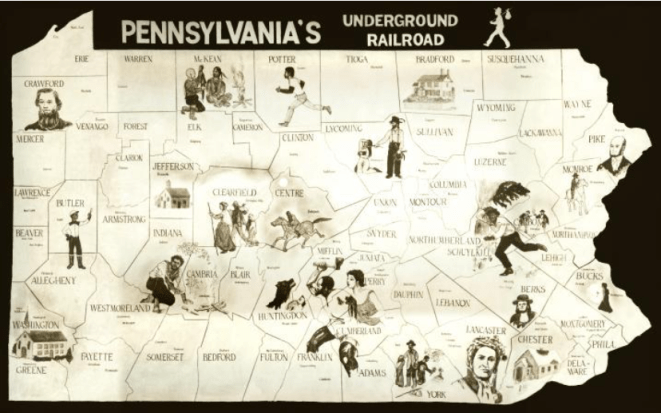
Original map design: oil on canvas, by Charles Hollingsworth, 1981. Image courtesy of the permanent collection of the African American Museum in Philadelphia.
Section Three: The National Association of Colored Women
Harper’s demotion in the WCTU, as well as the organization’s ongoing failure to support the issues she considered most significant, led Harper to co-found with Mary Church Terrell,the National Association of Colored Women’s Clubs (NACWC) in 1896. As the NACWC’s vice
president to Mary Church Terrell, Harper committed to expanding the organization’s reach and membership. She specifically advocated for demanding government action against lynching and other forms of white racial violence; increasing NACWC participation in suffrage parties and rallies to ensure that Black women’s voices were heard; and ensuring universal access to education for Black women–a lifelong initiative for Harper. Harper promoted many of these aims
through her work co-organizing the First Annual Convention of the National Association of Colored Women, held in July 1896 in Washington, DC, of which Ida B. Wells-Barnett was also an attendant. The convention was a success, boasting attendance from over one-hundred women’s clubs across the nation. Here you can find a link to the program for this first NACWC convention, and here you can find the minutes from the same convention, both from The Woman’s Era. In 1896, Harper delivered a powerful address entitled “The Ideal Home” that, Parker writes, “reflected the self-help approach that [NACWC and the WCTU] initially adopted in the increasingly hostile racial climate of the last decade of the nineteenth century” (163).
In 1891, she gave a speech to the “new predominantly white women’s organization, the National Council of Women, organized by Susan B. Anthony, May Wright Sewell, and Frances Willard” (163). While the National Council of Women assigned her the topic “Duty to Dependent Races,” Parker explains,
Harper asserted her independence by rejecting the narrowly conscribed and even racist topic by stating that she would be discussing ‘the negro not as a mere dependent’ but as ‘a member of the body politic who has claim upon the nation’ for–at minimum–justice and protection from violence. Insisting that blacks had been good patriots who had even fought in the American Revolution and subsequent wars for the United States, she demanded that whites fully recognize and Accept their legitimate claims to citizenship…Harper persisted in identifying the federal government as the most important agent for significant social change. (163-164)
Her insistence on the federal government as a catalyst for social change was based in many state government’s willful ignorance of the Thirteenth and Fifteenth Amendments, which granted Black Americans full citizenship and Black men voting rights, respectively. She supported black male suffrage through the Fifteenth Amendment, “but also argued in favor of immediately extending the vote to women” (Parker 150). Harper felt that the federal government was the only power which could enforce the amendment, protect Black Americans’ rights, and grant women suffrage. A few years after giving this address, Harper was elected as the NACWC’s Vice President, an office in which she served from 1897 to 1904 (Archives of Women’s Political Communication, “Frances Ellen Watkins Harper,” par. 4). Adding the title of National Superintendent of Clubs to her resume in 1900, Harper focused on women’s suffrage along with the rest of the NACWC. “Throughout the two decades before the ratification of the Nineteenth Amendment,” Terborg-Penn writes, the NACW listed a “‘Suffrage Department’[…] for disseminating information to educate club members about the benefits of supporting the woman suffrage movement” (92). Continuing Terrell’s legacy, Harper also supported efforts to create educational programs for Black women and children, and served as director of the American Association of Colored Youth.

“Frances Ellen Watkins Harper.”
Section Four: The Chicago World’s Fair of 1893
Black newspapers around the time of the Chicago World’s Fair of 1893 “labeled the exposition ‘the white American’s World’s Fair’” and were consistently rejected after proposing exhibits and offering to build some elements of the Chicago Fair (Paddon and Turner 21-22).
Moreover, there was “only one African American man, J.E. Johnson, [who] was appointed to a clerical position, while another clerical position was filled by Fannie Barrier Williams” (22).
However, Paddon and Turner assert, “Although fair officials frustrated the efforts of African Americans, a reflective look at those activities indicates that the foundations for black political, social, and artistic movements of the twentieth century were laid at the fair” (19). Similarly to the New Orleans Fair, while conditions for Black Americans were less than satisfactory and discriminatory, the Black exhibitors and participants themselves challenged racist treatment and affirmed themselves as skilled producers and intellectuals. Also like the New Orleans Fair, opinions among the Black community differed on whether to boycott the fair or use “the small roles permitted in order to increase visibility and push for greater involvement” (23). There were two groups who proposed avenues towards the inclusion of Black women to the Board of Lady Managers of the Chicago Fair; those groups were the Woman’s Columbian Association (WCA) and the Woman’s Columbian Auxiliary Association (WCAA). After petitioning the Board of Lady Managers, they too were rejected.
In her speech, she argued that women “stand on the threshold of woman’s era, and woman’s work is
grandly constructed” (Paddon, Turner 33). In addition to this address, Harper’s poem “The Mission of the Flowers” was exhibited in the “Poetry and Prose” section, unable to exhibit in the Women’s Department due to the discrimination of the Fair.
In protest of the active exclusion of Black Women at the Chicago World’s Fair, Harper and five fellow Black women creators, including Mary Church Terrell and Fannie Barrier Williams vocally opposed the Fair. This protest was held during the last week of the Fair and was called the “Congress of Colored Women.” Ida B. Wells-Barnett also showed solidarity with the movement, as did many more Black women whose support is less well-documented (Bertuca et. al). Wells-Barnett worked with other prominent activists to publicize and criticize the exclusion, creating and publishing a pamphlet titled The Reason Why the Colored American Is Not in the World’s Columbian Exposition. The Congress of Colored Women, as well as all those in support of their mission, were intent on showcasing the achievements of Black women and demanding recognition within the larger women’s suffrage movement.
Section Five: Literary Works
Harper’s first book, a collection of poetry titled Forest Leaves, was published in 1845 when Harper was twenty-years-old. In 1854, Harper gave “her first speech…in Massachusetts under
the auspices of the American Anti-Slavery Society[, after which she] subsequently lectured alongside other Garrisonian abolitionists, including Lucy Stone, Lucretia Mott, William Lloyd
Garrison, and Frederick Douglass” (Parker 147). The same year, she published her second collection of poetry, Poems on Miscellaneous Subjects. This second collection achieved mass
success and contains some of Harper’s best-known works such as “The Slave Mother,” “Eliza Harris,” “Ethiopia,” and “The Slave Auction.” Harper made her literary prowess an extension of
her activism; as the first Black woman lecturer for the American Anti-Slavery Society she often incorporated her poetry into her anti-slavery lectures as she traveled throughout the North (Black Women’s Organizing Archive).
In 1859, when Harper was thirty-four years old, her first short story was published in The Anglo-African, a popular Black-edited newspaper. Her short story was titled “The Two Offers,” and it “highlighted the problems with women’s legal and economic dependency in marriage…Critiquing men’s unrestrained power within marriage, Harper advocated for a ‘redemptive womanhood’ and rejected the notion that women should be weak or dependent” (Parker 146-148). In the text, Harper argues “the true woman–if you would render her happy, needs more” than a husband; she should also be educated or “enlightened” (Harper 109). In her 1866 speech, “We Are All Bound Up Together,” Harper explains her own experience with marriage:
My husband had died suddenly, leaving me a widow, with four children, one my own, and the others stepchildren. I tried to keep my children together. But my husband died in debt; and before he had been in his grave three months, the administrator had swept the very milk crocks and wash tubs from my hands. I was a farmer’s wife and made butter for the Columbus market; but what could I do, when they had swept all away? They left me one thing-and that was a looking-glass! Had I died instead of my husband, how different would have been the result! By this time he would have had another wife, it is likely; and no administrator would have gone into his house, broken up his home, and sold his bed, and taken away his means of support. (Harper 148)
Harper highlights the disproportionate effects of the death of a spouse for women in comparison to men; when her husband died, she lost everything. Parker explains, “Harper’s own savings from royalties and lecture fees paid for the farm, but this investment was legally her husband’s not hers, allowing his creditors to confiscate their marital property upon his death” (148). Under the law, men were in charge of property and owned everything, including his wife’s possessions. Once the husband died, the widowed wife would have no legal claim to property or belongings left behind, even if they were originally hers. Harper asserts, “then, that justice is not fulfilled so long as woman is unequal before the law” (148). Harper gave this speech at the Eleventh National Woman’s Rights Convention, which was held in New York. While centering racial cooperation among women in the address, Harper also “boldly challenged white women at the convention, first by questioning the long-held suffragist belief that the vote could correct the ills of the world” (148). Harper asserts, “I do not believe that giving the woman the ballot is
immediately going to cure all the ills of life” (148). She then demands “that white women examine their own complicity in racism,” stating,
I do not believe that white women are dewdrops just exhaled from the skies. I think that like men they may be divided into three classes, the good, the bad, and the indifferent[…]You white women speak here of rights. I speak of wrongs. I, as a colored woman, have had in this country an education which has made me feel as if I were in the situation of Ishmael, my hand against every man, and every man’s hand against me. (148).
Harper holds white women accountable, explaining that as a Black woman, she does not feel the community meant to be created among women’s clubs; she feels as though every man’s hand is against her, including white women’s. She gives a material example of this feeling of division; she states, “I would like to make [my home] in Philadelphia, near my own friends and relations. But if I want to ride in the streets of Philadelphia, they send me to ride on the platform with the driver. Have women nothing to do with this?” (150). Her question echoes Sojourner Truth’s “Ain’t I a Woman?” Are white women not also responsible in challenging the racist treatment Black women face in public spaces? She concludes asking, “Are there not wrongs to be righted?” (150).
Between the years of 1868 and 1888, three of Harper’s serialized novels were published in The Christian Recorder, another popular Black newspaper: Minnie’s Sacrifice, Sowing and Reaping, and Trials and Triumphs. In Minnie’s Sacrifice, Parker explains, the main character, Minnie “emphasized black women’s common humanity as the main reason for giving women the right to vote” (150). Harper used the character to argue for the equality of women and men across races in order to support suffrage for all people. She made a similar move in Sowing and Reaping, more overtly linking suffrage to temperance: “I want women to possess power as well as influence, I want every Christian woman as she passes by a grog-shop or liquor saloon, to feel that she has on her heart a burden of responsibility for its existence. On this liquor question there is room for woman’s conscience” (Harper, 160-61). Harper strongly believed that women would vote for prohibition of alcohol if given suffrage in opposition to men’s drinking habits which often destroyed families. Believing men would vote against the prohibition of alcohol, Harper felt women “needed the vote for self-defense” (Parker 150).
In 1872, she published another poetry collection titled Sketches of Southern Life in which Harper included poems such as “Aunt Chloe” and “Aunt Chloe’s Politics.” Each poem is from the point of view of an enslaved person in the South as they experience Lincoln’s assassination, the beginning of the Civil War, the separation of families and reunions, and southern enslavement. “Aunt Chloe’s Politics” offers opinions on voting as well as the government. Her third novel, Iola Leroy, or Shadows Uplifted, published in 1892, is considered one of Harper’s most significant not to mention recognizable works. Scholar Jennette Parish asserts, “In this historical novel, she spoke from a feminist point of view and projected African American women as sufferers, survivors, and participants in their future, an innovative concept in African American women’s literature” (MD State Archives, par. 15).
In 1894, she published a poetry collection titled The Martyr of Alabama and Other Poems. “The Martyr of Alabama” is a poem which honors a young Black boy named Tim Thompson who was murdered because he refused to dance for white folks (Atlanta offering: poems / Frances E.W. Harper). For both Sketches of Southern Life and The Martyr of Alabama and Other Poems, Harper used the experience she gained from working with the Freedman’s Bureau and teaching freed Black folks in the South to construct narratives of southern life for enslaved and free Black Americans (Black Women’s Organizing Archive, par. 4). Also in 1894, “the same year as a major debate about Frances Willard and the WCTU’s stance on lynching generated by antilynching advocate Ida B. Wells,” Harper published “How to Stop Lynching” in the Women’s Era. Stressing the importance of the central government, Harper writes,
No, the truth is this, nothing is to be expected from the South. The colored people must look to the general government. It has a right to their services and lives in time of war. They have a right to its protection certainly in time of peace…If the United States government can protect money, the property of its citizens against destruction at the hands of the counterfeiter, it can protect the owners of the property against the loss of life at the hands of the murderer. It is an astounding proposition that a great nation is powerful enough to stop white moonshines from making whiskey but is unable to prevent the moonshiners or any one else from murdering its citizens. (The Woman’s Era, Vol 1, No. 2, 8-9)
She goes on to list that in which the U.S. government chooses to intervene: protection of corn, prevention of tobacco sales, and going to war, in comparison to the continued murders of Black Americans with no protection offered from the federal government. She concludes, “It can stop lynching, and until it does so, it has on its hands the innocent blood of its murdered citizens” (The Woman’s Era, Vol 1, No. 2, 9). While Ida B. Wells-Barnett focused on holding state governments accountable, Harper’s work centered around holding the government accountable for its complacency in the face of thousands of lynchings.
Harper’s work often addressed the experiences of herself and the women around her and, as such, should be recognized for its important contribution to the representation of life as a Black woman in the nineteenth century. At the same time, Harper’s inclusion on overt political themes has sometimes resulted in a comparative lack of scholarship attendant on her aesthetics.
Featured below is Frances Harper’s most recognized poem, titled “The Slave Mother.” The poem describes a mother’s forceful separation from her child, an experience that was all too common amongst enslaved women.


Works Cited
“Frances Ellen Watkins Harper.” Black Women’s Organizing Archive, bwoaproject.org/harper. Accessed 25 Apr. 2023.
“Frances E. W. Harper.” BlackPast, 27 Nov. 2007, www.blackpast.org/african-american-history/frances-ellen-harper-branch-women-s-christian-temperance-union-1891-1895. Accessed 25 Apr. 2023.
“Frances Ellen Watkins Harper.” Iowa State University: Archives of Women’s Political Communication, awpc.cattcenter.iastate.edu/directory/frances-ellen-watkins-harper. Accessed 25 Apr. 2023.
“Frances Ellen Watkins Harper.” Wikipedia, en.wikipedia.org/wiki/Frances_Ellen_Watkins_Harper. Accessed 25 Apr. 2023.
Hollingsworth, Charles. “William Still: An African American Abolitionist,” 1981, stillfamily.library.temple.edu/stillfamily/exhibits/show/william-still/historical-perspective/reflections-on-the-underground. Accessed 25 Apr. 2023.
Parish, Jenette. “Frances Ellen Watkins Harper (1825-1911).” Archives of Maryland (Biographical Series), MSA SC 3520-12499. Maryland State Archives, msa.maryland.gov/megafile/msa/speccol/sc3500/sc3520/012400/012499/html/12499bio.html. Accessed 26 Mar. 2023.
Parker, Alison M. “Frances Watkins Harper and the Search for Women’s Interracial Alliances.” Boydell & Brewer: University of Rochester Press, 2013. Accessed 23 Apr. 2023.
Quinn, Hallie. “Mrs. F.E.W. Harper.” Courtesy of Documenting the American South. Colored Conventions Heartland, 2016, coloredconventions.org/ohio-organizing/biographies/frances-ellen-watkins-harper. Accessed 24 Apr. 2023.
Ruffin, Josephine St. Pierre. “The Women’s Era” v.2:no.2 (1895: May). Women’s Era Club, ark.digitalcommonwealth.org/ark:/50959/9593xc69v. Accessed 24 Apr. 2023.
Terborg-Penn, Rosalyn. African American Women in the Struggle for the Vote, 1850-1920. Indiana University Press, 1998.
Wall, Cheryl A. Women of the Harlem Renaissance. Indiana University Press, 1995.
“William J. Watkins Sr.” Watkins Education, 2014, www.watkinseducation.org/about-us. Accessed 25 Apr. 2023.