Educational Resource Library & Archive
Recovering the 1884 Woman’s Literary Department for the 21st Century
Develop a Recovery Exhibit
As a class, students will design and create an online exhibit to be published as part of the digital humanities project, This Beautiful Sisterhood of Books (thisbeautifulsisterhood.org).
Course
Nineteenth-Century Black Women Writers
Author
Katherine Adams
Lesson Objectives
Plan Collaboratively
Develop an exhibit plan through collaborative brainstorming, selection, and editing
Propose an Exhibit Item
Write a proposal for an exhibit item relating to the class’s exhibit topic.
Conduct Research
Write an annotated bibliography that synthesizes primary and secondary research on the item’s topic.
Develop and revise an exhibit
Develop and revise an exhibit through workshops, draft creation, and a revision process.
Instructions
The following modules discuss lessons for implementing this curriculum for developing a recovery exhibit in your classroom.
Context
For your final writing project(s) you will research one work from the Woman’s Literary Department at the 1884 New Orleans World’s Fair. You will create three pieces of scholarship, drawn from this research: an oral presentation to be delivered during the final week. As a group, we will design and create an online exhibit to be published as part of the digital humanities project, This Beautiful Sisterhood of Books (thisbeautifulsisterhood.org). The focus of our exhibit will be the scholarly recovery of the exclusion of Black women from the Women’s Department at the 1884 New Orleans World’s Fair. Some of this work will be collaborative, as we decide what historical and theoretical topics to include and how to present them. Some of this work will be individual, as you research your chosen topic and develop your contribution.
- This Beautiful Sisterhood Annotated Bibliography
- This Beautiful Sisterhood Exhibit Draft
- This This Beautiful Sisterhood Exhibit Revision
In-Class Workshop: Finding a Topic Cluster
Conduct a brainstorm on the board with your class discussing the topics and scope of your exhibit’s contributions. You may want to create your own wishlist for your exibhit similar to the one in this cluster.
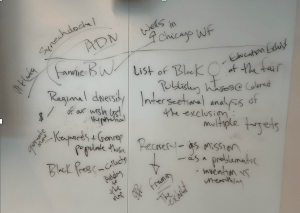
Below is an example of what our brainstorm produced. Please consult the wishlist as a jumping off point for your new exhibit.
For our exhibit, we described an account of the exhibit as a whole, and what it means to “Recover the Exclusion.”
- Your exhibit will need a landing page with an quick introduction that describes the content of the exhibit you are creating. In our case, we discussed the overaching theme of Recovery Scholarship. In this introduction, we wanted to focus on what recovery is (and what it is not), why it matters, the status of the recovery of early Black women’s writing, problems and paradoxes to keep in mind, methods.
- Keep in mind that as new pieces are created, we can link across the site to existing content. Your students will want to indicate these connections with parthensis. Example: Your Content (link to synecdochal figures or speculative recovery page)
- We decided to create a list of Black Women exhibitors at the Exposition (and as much information as we can find about each). We can look in the Colored Department as well as the Education Department.
- We also wanted to develop an Intersectional Analyses of the exclusion, with targets that may include:
- Speeches and articles about the “Woman’s Department,”
- The contents of the Woman’s Department exhibit,
- The contents of the Woman’s Department’s literary department specifically: The location of the Woman’s Department Exhibit and its literary alcove.
- The predicament of choosing, as Black women, between the “Woman’s” and the “Colored” depts and what that means for our project.
- Speeches and articles about the “Woman’s Department,”
- We also decided to create a gathering of coverage in the Black press – of the Woman’s dept and the Colored dept, when possible.
- We wanted to conduct a deeper dive on Fannie Barrier Williams at the Fair as our Synechdochal Figure who links us to…
- Williams’s shift into a writing career (see exhibited as an artist in New Orleans)Williams’s prominent role at the Chicago Fair in 1893Other Black women, including Wells, Mary Church Terrell, and Frances Harper, in Chicago in 1893Alice Dunbar-Nelson, who was in Nola but 11 years old in 1884 and became a writer (see her piece about the Atlanta Fair here, under “Club Notes: Louisiana”: https://womansera.digitalscholarship.emory.edu/volume-2-number-3/#era2_03.07)
- We decided to develop a wish list of Black Women Writers for the Literary Department
- Organize it via the states, genres, and keywords used for the database (so that Black women appear alongside white women via those searches) – eg: religion, motherhood, etc.Allow our wish list to generate new search terms (genre, states, keywords) as appropriate
- We wanted to create a super-cool map that plots the regional diversity (and potentially the movement?) of…
- Black women exhibitors in Nola, Synechdochal links, Black press coverage, and our wish list of Black women writers.
Writing an Exhibit Item Proposal
- Should be a page or so, can be informal. Your audience is the exhibit team (everyone in the class, your professor, and any technnical stakeholders).
- Identifies your firm choice of topic and approach.
- Hypothesizes what you will find (and/or argue).
- Explains how your piece will fit into the exhibit as a whole.
- Considers what formats could work, pros and cons.
- Includes any questions you have for me at this point.
- As the instructor, you may want to provide students with the goals and topic ideas summarized like the example below:
- The Exhibit end goal
- Recovery of the exclusion of Black women from the Women’s Dept at the 1884 World’s Fair
- multiple modes of asking our questions, posing our disruptions, telling our stories
- content on Black women at the Fair, on the racialized underpinnings of the Women’s Department, and on the ethics and politics of recovery scholarship
- Topics Ideas:
- Fannie Barrier Williams
- Assembling of Fair coverage in the Black Press
- List of all names recoverable of Black women who did exhibit
- Network Analysis of Black women at the fair and beyond
- Research on Black women at Atlanta, Philly, & Chicago Fairs
- Analysis of racializing content/structure of Women’s Department
- Black New Orleans in the 1880s
- Black schoolteachers in DC in the 1880s
- Literary Recovery Scholarship and Race
- Intersection analysis of the exclusion
Writing an Annotated Bibliography for your Exhibit Item
- Must include 7-10 sources, 5 of which should be scholarly and peer-reviewed.
- An annotated bibliography is simply a bibliography that includes an explanatory paragraph for each item.
- For this project, each annotation should:
- provide a quick overview of the item’s content or (if scholarly) topic and central argument;
- characterize its method or approach
- for primary sources: what is its format, where is it located?
- For scholarly sources: does it come from a feminist perspective? psychoanalytic? ideology critique? explain your answer); and
- explain its relevance to your developing part of the exhibit
- will you link to it (a database) or quote from it within your piece?
- If scholarly: will you agree with and expand upon the critic’s findings? will you disagree in a way that helps sharpen and refine your focus?).
- Learn more about annotated bibliographies.
In Class Workshop: Creating a Collaborative Charter
Now that you have submitted your proposal, as a class, we will work toward a collective Charter and framework for your BSB exhibit. The new piece will entail responding to the following prompts. Your answers don’t need to be long. In fact, concision will be a virtue, since you’ll be combining everyone’s input into a joint statement. The prompts we agreed on are these
- What hopes do we have for what becomes of our work, and what comes after:
- Who we are, as a group:
- What we are doing with this exhibit, and why:
- What concerns do we have about this project/what limits do we perceive or foresee.
You may want to collect your group’s thoughts in a shared doc such as “Notes Toward a Collaboration” link.
Workshop Two: Exploring the BSB Exhibits
Students explore exhibit samples on the Beautiful Sisterhood site together and come up with a class check list on what they need to consider when creating one of their own. Students should design their exhibits based on the source material that they have:
- locational data = maps;
- change over time = timelines;
- archival material = database
This is a great time to bring in any techncial collaborators to discuss digital tools and considerations.
. .
In-Class Workshop: Exploring the BSB Exhibits
Students explore exhibit samples on the Beautiful Sisterhood site together and come up with a class check list on what they need to consider when creating one of their own. Students should design their exhibits based on the source material that they have:
- locational data = maps;
- change over time = timelines;
- archival material = database
This is a great time to bring in any techncial collaborators to discuss digital tools and considerations.
In-Class Workshop: Data Feminism
At home, read: D’Ignazio, C., & Klein, L. (2020). 3. On Rational, Scientific, Objective Viewpoints from Mythical, Imaginary, Impossible Standpoints. In Data Feminism. Retrieved from https://data-feminism.mitpress.mit.edu/pub/5evfe9yd
In class, discuss how to incorporate the following design goals into your exhibit research and outputs. Refer back to the chapter for specific advice from the authors about working with data projects.
- Include non-white knowledge production, make space for ongoing non-white knowledge production (new work, interpretive input).
- Help users to reflect on the white, western-centric forms that typically govern knowledge production; be transparent and meta-reflective on our own formal choices.
- Be judicious about our choice of research sources; be transparent about these on the site.
- Demonstrate, and help users understand, the relational (vs additive) dynamics of our recovery work.
- Represent the embodied and emotional dimensions of data.
- Synecdochal strategies without speculative presumptions.
Develop an Exhibit Draft and Revision
For your final writing project(s) you will research one work from the Woman’s Literary Department at the 1884 New Orleans World’s Fair. You will create three pieces of scholarship, drawn from this research: an oral presentation to be delivered during the final week As a group, we will design and create an online exhibit to be published as part of the digital humanities project, This Beautiful Sisterhood of Books (thisbeautifulsisterhood.org). The focus of our exhibit will be the scholarly recovery of the exclusion of Black women from the Women’s Department at the 1884 New Orleans World’s Fair.
- The Exhibit end goal
- Recovery of the exclusion of Black women from the Women’s Dept at the 1884 World’s Fair
- multiple modes of asking our questions, posing our disruptions, telling our stories
- content on Black women at the Fair, on the racialized underpinnings of the Women’s Department, and on the ethics and politics of recovery scholarship
- Topics Ideas:
- Fannie Barrier Williams
- Assembling of Fair coverage in the Black Press
- List of all names recoverable of Black women who did exhibit
- Network Analysis of Black women at the fair and beyond
- Research on Black women at Atlanta, Philly, & Chicago Fairs
- Analysis of racializing content/structure of Women’s Department
- Black New Orleans in the 1880s
- Black schoolteachers in DC in the 1880s
- Literary Recovery Scholarship and Race
- Intersection analysis of the exclusion
Specifications for Written Components
- typed and double-spaced with 1-inch margins.
- MLA style citation and documentation of sources.
- hard copies to my mailbox and ecopy to SafeAssign by deadlines.
What I’ll Look For in Written and Oral Components:
- evidence of a thorough and creative research process.
- original ideas – in content and presentation style.
- an effort to interest and engage your audience (especially in the exhibit label, but also the research paper).
- logical organization, clarity, beautiful and fascistically-proofread prose.
Instructor Notes
For this assignment, students select works from the topic and wish list. The editors of the This Beautiful Sisterhood of Books Project keeps this list updated. Instructors are encouraged to work with their students to submit Exhibit Labels to the project for possible publication.
For this module, you willl need to plan for a significantly early due date for “finalized work” so work can be revised and refined in class.
For this assignment, we built cross-department collaborations. I supported students on developing the content as their professor and Professor Jacquelyne Howard, who is an historian of the 19th US as well as an expert in the digital humanities help us imagine and execute approaches to digital and public-facing storytelling. I suggest working with digital humanities or technical experts from the library or related departments.