By Julia Creson
The New Orleans World’s Fair of 1884 and the World’s Columbian Exposition of 1895, held in Chicago, provide an opportunity for examining constructs of “womanhood” and “Blackness” as they affected Black women at the turn of the century. To foreground the resistance work Black women undertook at the New Orleans and Chicago fairs, we must understand the racialized and gendered constructs that Black women confronted at that time. In “Seductions and the Ruses of Power,” Saidiya Hartman traces how nineteenth-century common law and slave law defined enslaved Black women as both person and property. Being property meant it was legally impossible for Black women to resist or consent to sexual advances. And that status led to their construction, as inherently lascivious persons, assumed always available and willing (538-39). Sexuality became a tool used by white men to remove their own culpability as rapists and instead place blame on the Black enslaved woman, a strategy that ultimately took the form of the racist Jezebel stereotype. Hartman emphasizes that this legal position and false
narrative made enslaved Black women incapable of consensual sexual relations with any man, even Black enslaved men, since the law did not protect Black women against rape in any context.
I cite this point not to criminalize enslaved Black men, but rather to demonstrate–as Hartman does–the inextricable link between the gender of enslaved Black women and vulnerability to sexual violence. Hartman writes,
Here it is not my intention to reproduce a heteronormative view of sexual violence as only and always directed at women . . . but rather to consider the terms in which gender, in particular the category of ‘woman,’ becomes meaningful in a context in which subjectivity is tantamount to injury. The disavowal of sexual violence is specific not only to female engenderment but to the condition of enslavement in general. (555)
While sexual violence is inextricable from the condition of enslavement for all genders, the category of “woman” is unique as a gender that was particularized in this way by its intersection with race. Unlike enslaved Black women, white women were protected against rape by common law and, to some extent, by the domestic ideology that defined them as chaste and pure. This difference, Hartman shows, was categorical: free white womanhood constituted a different gender than the construct of enslaved Black womanhood (555-56). Thus, we must understand
that the category “woman” is not universally available, not inhabited in the same way across racial differences.
In particular, Hartman’s work helps us understand the different ways that Black women at the 1884 fair challenged the Woman’s Department’s representation of femininity as always already white. When the Colored Ladies Exposition Association met with Julia Ward Howe to ask to be a part of the Woman’s Department, Howe failed to act on their behalf. In doing so, she reified womanhood as white, while also denying Black women a chance to revise, expand, and redefine the exclusionary concept of womanhood established by slavery. Rather than being “very
unwilling” to exhibit with Black men, as Howe suggests, her visitors may have wanted to build an alliance to resist the patriarchy more effectively as an organized group of women across the racial spectrum (Pfeffer 79). Although they were excluded, Black women like Fannie Barrier
Williams and Sarah Shimm still challenged ideologies about Black womanhood by exhibiting with the Colored Department.
It’s clear that the racialized gender formation Hartman explains continued to shape US culture long after emancipation. Just 50 years ago, Akasha (Gloria T.) Hull and Barbara Smith argued that the white stereotyping of Black women as lascivious was one reason Black women had not been recognized in academia as educators or scholars, even though many Black women in the late nineteenth century were both teachers and activists. Hull and Smith write, “Our legacy as chattel, as sexual slaves as well as forced laborers, would adequately explain why most Black women are, to this day, far away from the centers of academic power and why Black women’s studies has just begun to surface in the latter part of the 1970s” (18). To illustrate, they provide the example of Milla Granson:
Milla Granson learned to read and write through the exceptional indulgence of her white
masters. She used her skills not to advance her own status, but to help her fellow slaves,
and this under the most difficult circumstances. The act of a Black person teaching and
sharing knowledge was viewed as naturally threatening to the power structure. The
knowledge she conveyed had a politically and materially transforming function, that is, it
empowered people to gain freedom. (18)
I contend we can apply a similar line of thinking to the Black women educators who presented at the New Orleans fair and those involved with the Chicago fair. While they were not working within the confines of enslavement, educators like Fannie Barrier Williams, Frances E.W. Harper, Ida B. Wells-Barnett, and Sarah Shimm were working against racism and stereotypes that inhibited Black women from obtaining employment, gaining civil rights, and supporting themselves and their families. Like Milla Granson, who threatened the power structure by educating her fellow enslaved people so that they could obtain their freedom, Williams, Harper, Wells-Barnett, and Shimm demonstrated that nineteenth-century Black educators were inherently revolutionary.

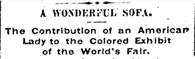
Sarah Shimm was a teacher from Washington D.C. as well as a columnist who wrote about racial tensions under the pen name Faith Lichen. Like fellow teacher, Williams, she also extended her commitment to radical pedagogy to the fair itself. Shimm threatened the racial capitalist power structure by exhibiting a sofa on which she had embroidered the story of Haitian revolutionary Toussaint L’Ouverture. Scholar Katherine Adams discusses Shimm’s revolutionary sofa embroidered with the story of Toussaint L’Ouverture in “Becoming Global: Gender, Race, and Cognitive Mapping at the 1884 World’s Fair.” Ostensibly, the sofa, a quintessential household piece, represented women as limited to the domestic sphere, a construction the Woman’s Department was criticized for perpetuating (Adams 33). However, Adams writes, “If white women chose domesticity over self-commodification, Shimm’s sofa refuses fungibility even more emphatically with its unwieldy size and extravagantly unreproducible needlework” (33). If white women resisted capitalist ideals of self- commodification through domestic work, then Shimm elevated that resistance by making a singular, “unreproducible” piece of work. Fairgoers who saw Shimm’s sofa would learn about L’Ouverture, Black global history, and what Adams calls “a radical Black global imaginary” (32). Shimm imagined a radical future for Black Americans that refuses to be defined by one idea or construct through her presentation of different histories and imaginings of Black liberation. About Shimm and her sofa, Adams writes,
Although often congratulated on their recent emancipation by speakers like Howe, many Black fairgoers had descended from Haitian immigrants and been free for generations. Through L’Ouverture, Shimm rejects the racial imaginary that dates Black freedom from “just two decades ago,” credits it to white benevolence, and aligns it with (deferred) US democratic belonging. The caption embroidered beneath his portrait, “First of the Blacks,” asserts a claim that is hierarchical—prioritizing resistance to white culture rather than emulation of it—and temporal: it designates an alternate moment and location for the emergence of global Blackness. (36)
Shimm’s sofa was an act of resistance against white American culture, which assumed all Black fairgoers had been emancipated due to the kindness of white Americans, also exemplifying the white American association of all Black people with enslavement.

By “prioritizing resistance to white culture rather than an emulation of it,” her sofa was a resistance to white American capitalist culture, even while many Black Americans aimed to integrate themselves into that very culture by exhibiting at the fair. Because she focused on foregrounding Black history, resisting capitalist aims, and deconstructing notions of the domestic space as unproductive, Shimm’s exhibition of her sofa exemplifies an early act of intersectional Black Feminism. As the excerpt from July of 1885 on the left details, Shimm passed away shortly after her sofa was exhibited at the world’s fair. Writing about Elizabeth Keckley’s memoir, scholar Xiomara Santamarina explains that “southerners who sought to assert their authority over the former slaves promoted stereotypes of freedmen as ‘lazy’ and unwilling to work” (516). Shimm’s exhibition of an unfettered image of Blackness threatened the authority white Americans attempted to assert over those who were former slaves and those who were assumed to be former slaves because they were Black. Although Sarah Shimm is only one example, her exhibit represents the exceptional educational and activist work that was deployed by Black women both at and outside of the fair. Shimm and her sofa represent the prototypical Black feminism deployed by Black women in the late nineteenth century: work that challenges racial and gendered essentialisms and the capitalist economy.
Like Shimm, Fannie Barrier Williams viewed world’s fairs as avenues for spreading Black activist pedagogy through exhibits, speeches, and curation. Barrier Williams, Frances E.W. Harper, and Ida B. Wells-Barnett were involved in the World’s Columbian Exposition of 1895 in Chicago. Like the New Orleans fair, the Chicago Exposition was a scene of tension between white and Black Americans. The Chicago Exposition prioritized white exhibitors and organizers; Black press at the time referred to the exposition as “the white American’s World’s Fair” (Paddon and Turner 21-22). Black Americans chose to challenge this racist exclusion in two ways: either boycott and protest the fair through writing or participate to increase representation and involvement using the limited roles they were assigned. For example, Barrier Williams was appointed as a clerk in charge of Black folks’ interests at the fair, one of three Black representatives assigned to work the fair. In this role, Barrier Williams was a part of the organization of the World’s Congress of Representative Women. At the week-long congress, Barrier Williams gave an address titled “The Intellectual Progress of the Colored Women of the United States since the Emancipation Proclamation.” Although few Black women were able to participate in Chicago’s fair, Barrier Williams used her position to ensure Black women were included, discussed, and recognized for their activist work. Moreover, she argued for more employment opportunities for Black women and solidarity between Black and white women, a move which supports the claim that Black women may have wished to ally themselves with white women at the New Orleans fair ten years earlier. Frances E.W. Harper also addressed the Women’s Congress with a speech titled “Woman’s Political Future,” in which she suggested that women “stand on the threshold of the woman’s era, and woman’s work is grandly constructed” (Paddon, Turner 33). In addition, Harper exhibited her poem “The Mission of the Flowers” in the “Poetry and Prose” section of the fair. This poem uses flowers as a metaphor for the oppressive nature of the objectification of women. Like Shimm, both Barrier Williams and Harper used their limited positions at the Chicago fair to spread their Black activist pedagogy, majorly centering Black women in their approaches.
Ida B. Wells-Barnett applied her own Black activist pedagogy to her work around the Chicago fair. Along with Frederick Douglass, Irvine Garland Penn, and Ferdinand Lee Barnett, Wells-Barnett wrote a pamphlet titled The Reason Why the Colored American Is Not in the World’s Columbian Exposition. The pamphlet provides an in-depth discussion of the exclusion of Black intellectuals and creators by the Chicago fair officials. Unlike Barrier Williams’ and Harper’s strategies, Wells-Barnett was in support of Black Americans boycotting the fair, including on August 25th, the day designated as Colored People’s Day. Wells-Barnett criticized a stereotypical cartoon of Black folks which was used to advertise the day, believing attendance would reinforce the negative image. Later acknowledging the effectiveness of the speeches given by Black folks on Colored People’s Day in deconstructing those negative images, Wells-Barnett recognized the power of Black folks’ participation in the fair to spread Black activist pedagogy even while doing the same through a boycott.
Shimm, Barrier Williams, Harper, and Wells-Barnett exemplify the important activist work Black women intellectuals deployed at fairs in this era. Their work truly speaks for itself, creating an archive of Black women’s work at World’s Fairs which would lay the groundwork for future Black activist pedagogy which centers Black women.
Works Cited
Hartman. (n.d.). Seduction and the Ruses of Power. Callaloo., 19(2), 537–560. https://doi.org/info:doi/ But Some of Us Are Brave (p. 17-79). The Feminist Press at CUNY. Kindle Edition.
PFEFFER, MIKI. “‘Mr. Chairman and FELLOW AMERICAN CITIZENS’: African American Agency at the World’s Industrial and Cotton Centennial Exposition in New Orleans, 1884-1885.” Louisiana History: The Journal of the Louisiana Historical Association, vol. 51, no. 4, 2010, pp. 442–62. JSTOR, http://www.jstor.org/stable/25800987. Accessed 26 Mar. 2023.
Jones, Claudia. “An End to the Neglect of the Problems of the Negro Woman!” Words of Fire: An Anthology of African-American Feminist Thought, Duke University, Durham, NC, 1995, pp. 107–124.
Adams, Katherine. “Becoming Global: Gender, Race, and Cognitive Mapping at the 1884 World’s Fair.” J19: The Journal of Nineteenth-Century Americanists, vol. 8 no. 1, 2020, p. 11-41. Project MUSE, doi:10.1353/jnc.2020.0005.
“A Wonderful Sofa. The Contribution of an American Lady to the Colored Exhibit of the.” Cleveland Gazette, 10 Jan. 1885, p. 1. Readex: African American Newspapers, https://infoweb-newsbank-com.eu1.proxy.openathens.net/apps/readex/openurl?ctx_ver=z39.88-2004&rft_id=info%3Asid/infoweb-newsbank-com.eu1.proxy.openathens.net&svc_dat=EANAAA&req_dat=0D5BC155A19C48AA&rft_val_format=info%3Aofi/fmt%3Akev%3Amtx%3Actx&rft_dat=document_id%3Aimage%252Fv2%253A12B716FE88B82998%2540EANAAA-12CC2DE33AD89B10%25402409552-12CBE5CDF0403FC8%25400-12E03CA7A96B6C90%2540A%252BWonderful%252BSofa.%252BThe%252BContribution%252Bof%252Ban%252BAmerican%252BLady%252Bto%252Bthe%252BColored%252BExhibit%252Bof%252Bthe. Accessed 12 Mar. 2024.
Santamarina, Xiomara. “Behind the Scenes of Black Labor: Elizabeth Keckley and the Scandal of Publicity.” Feminist Studies, vol. 28, no. 3, 2002, pp. 515–37. JSTOR, https://doi.org/10.2307/3178784. Accessed 25 Mar. 2023.
Paddon, Anna R., and Sally Turner. “African Americans and the World’s Columbian Exposition.” Illinois Historical Journal, vol. 88, no. 1, 1995, pp. 19–36. JSTOR, http://www.jstor.org/stable/40192873.